
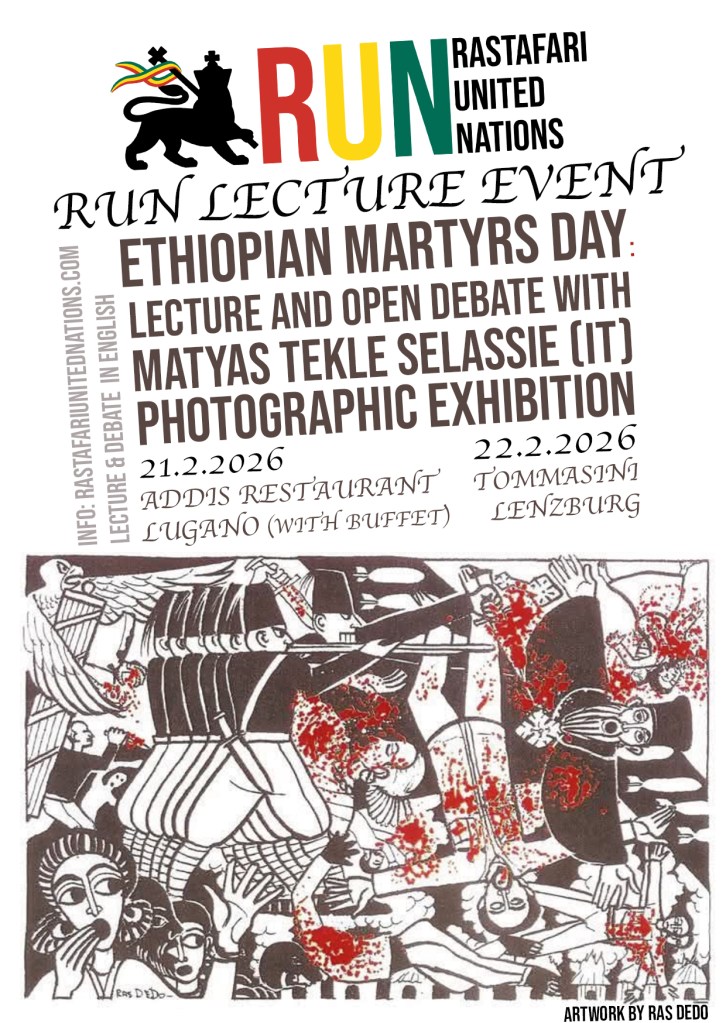
Program / Locations
21.2.2026
Addis Restaurant Lugano
www.addisristorante.ch
Entry: free (Buffet 25.-)
Start Time: 12:00 – 16:00
Programm:
12:00 Doors open, Ethiopian food buffet
13:00 Photographic exhibition
14:00 Lecture
15:00 Open debate
22.2.2026
Tommasini
Lenzburg
www.tomm.ch
Entry: 15 .-
Start Time: 15:00 – 19:00
Programm:
15:00 Doors Open, Art and Craft, Photographic Exhibition
16:00 Lecture
17:00 Open Debate
18:00 Art and Craft, Photographic Exhibition
Topic
The Fascist invasion of Ethiopia, which took place on October 3, 1935, resulted in approximately one million innocent deaths and incalculable environmental and moral damage. It employed inhumane methods prohibited by international conventions, such as poison gas, and the common practice of violence and abuse against civilians. It represents a shameful chapter in national history, yet it is systematically ignored in schools and silenced by political institutions. As many historians have observed, the Italo-Ethiopian conflict marked the beginning of the international crisis that would lead to World War II, as well as being one of the most decisive factors in the political and economic overthrow of Fascism. The Ethiopians were the first to confront it militarily—even before the formation of European partisan bands—and the first to achieve the liberation of their national territory from Axis forces in May 1941.
The Ethiopian people’s strenuous struggle, under significantly inferior technological conditions to their invaders, constitutes a coherent, morally balanced, and humanitarian anti-fascist inspiration, a cornerstone of the anti colonial struggle that deserves to be understood, like also the dynamics of the conflict and the perspective of the Ethiopians, who were attacked without provocation and racially discriminated even before the European Jews. The genesis of the conflict—determined by the violation of international law as enshrined in the then-existing League of Nations—and its subsequent global conflagration constitute an important precedent of Western political immorality, propagandistically disguised as a civilizing mission. This precedent bears many parallels with current international events such as the Palestinian genocide, and offers powerful keys to their interpretation.
A forgotten holocaust that, in the month of February, internationally dedicated to Black History, and close to the Ethiopian Day of Commemoration of Anti-Fascist Martyrs (February 19), we propose to rediscover and revisit with the contribution of the ethiopist scholar Matyas Tekle Selassie.
The Host
Matyas Tekle Selassie is a philosopher, writer, historical researcher, ethiopist scholar, and teacher of Geez (Ancient Ethiopic) language and literature. For approximately 25 years, he has been involved in disseminating Ethiopian culture and history nationally and internationally through lectures, seminars,
and public events in academic environments and at relevant cultural associations and centers, with particular reference to the Italo-Ethiopian conflict and the Italian colonial experience. He is the author of the largest Italian website dedicated to Rastafari and Ethiopian culture, http://www.rastafari-regna.com, and has produced numerous texts, both in Italian and English, including essays on theology, history, and linguistics, poetry, and translations from Ethiopian and other international literature in English and French.


 Rastafari United Nations